
Inflammation and the Microbiome
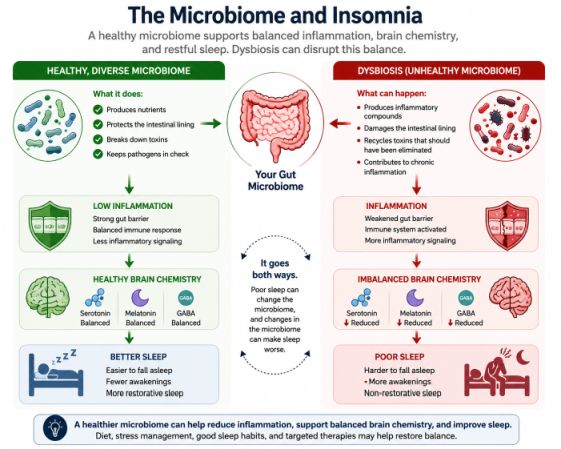
The bacteria that live in your intestines (the microbiome) play an important role in health and disease. One way they do this is by influencing inflammation. It is an ecosystem with as many bacterial cells in your intestine as there are cells in your entire body. When healthy and diverse, it produces nutrients, protects the intestinal lining, breaks down toxins, and keeps pathogens in check.
When the microbiome becomes less diverse or is overgrown with undesirable microbes, it can produce inflammatory compounds, damage the intestinal lining, recycle toxins that should have been eliminated, and contribute to chronic inflammation. Many studies link the microbiome to inflammation and many chronic conditions [1-7].
Microbiome Differences Between People Who Sleep Normally and People with Insomnia
Recent genetic studies suggest the relationship goes both ways. Certain groups of gut bacteria appear to influence the risk of insomnia, while chronic insomnia may also alter the composition of the gut microbiome [8,9].
The microbiome doesn’t influence sleep through just one pathway. Researchers believe gut bacteria communicate with the brain through immune signals, hormones, the vagus nerve, bacterial metabolites, and neurotransmitters. This helps explain why changes in the microbiome may affect inflammation, mood, and sleep simultaneously [10].
Probiotics and postbiotics may regulate sleep by influencing gut microbiota and their metabolites through immune, endocrine, and neural pathways [10].
Many Causes of Insomnia
Addressing inflammation and improving the health of the microbiome can help with insomnia. These are not the only causes of insomnia, but they are core health issues that can improve the length and quality of life. For that reason, you should ask, “Why do I have insomnia?” rather than, “How do I get rid of insomnia?”
Selected References
- Nat Rev Microbiol. 2017 Oct;15(10):630-638. The resilience of the intestinal microbiota influences health and disease
- Sci Rep. 2018 Feb 1;8:2183. The mechanistic link between health and gut microbiota diversity
- Int J Environ Res Public Health. 2020 Oct 19;17(20):7618. The Gut Microbiota and Inflammation: An Overview
- Immunity Volume 56, Issue 12, 12 December 2023, Pages 2719-2735.e7 Intestinal microbiota-specific Th17 cells possess regulatory properties and suppress effector T cells via c-MAF and IL-10
- Journal American Chemical Society(2025) 147 (4): 2998–3002. Unusual Phospholipids from Morganella morganii Linked to Depression
- Biomedicine & Pharmacotherapy Volume 164, August 2023, 114985 Immunological mechanisms of inflammatory diseases caused by gut microbiota dysbiosis: A review
- Front Immunol. 2024 Feb 2;15:1297240 The associations between gut microbiota and inflammatory skin diseases: a bi-directional two-sample Mendelian randomization study
- General Psychiatry 12/08/2025 Investigating bidirectional causal relationships between gut microbiota and insomnia
- Sleep Med. 2020 Aug:72:93-108. “Circadian misalignment and the gut microbiome. A bidirectional relationship triggering inflammation and metabolic disorders”- a literature review
- Journal of Advanced Research Volume 82, April 2026, Pages 267-293 Insomnia: the gut microbiome connection, prospects for probiotic and postbiotic therapies, and future directions





