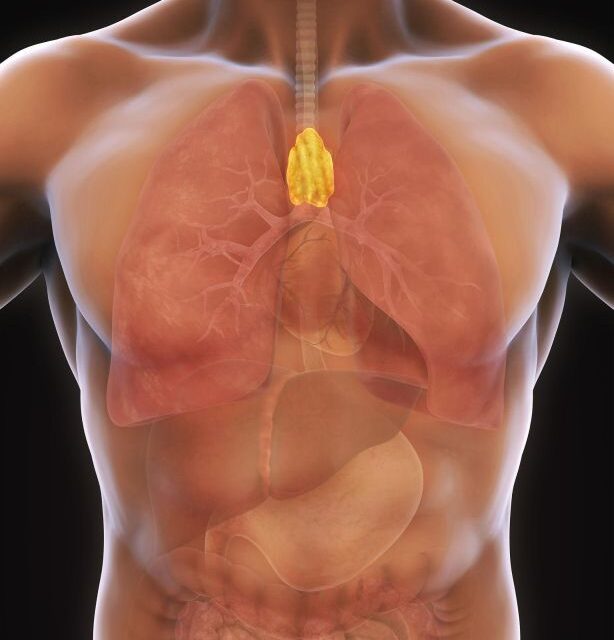
Why Would Thymus Extract Be Studied for Hepatitis?
The thymus plays an important role in directing the immune system. It is especially important for the development and function of T cells, which help the body recognize and respond to viruses, abnormal cells, and other threats. Thymic extracts and peptides can also influence natural killer cells, B cells, and other parts of the immune response [1].
Interestingly, thymus doesn’t simply “boost” immunity; it can help regulate the immune response. Researchers have studied thymus preparations in viral infections, immune deficiencies, and autoimmune diseases. In a 1979 study, five of eight patients with T-cell deficiencies experienced both immunologic recovery and clinical remission after treatment with the bovine thymus extract thymostimulin [4].
Research on calf thymus extracts dates back to the 1960s. Since hepatitis can involve both viral infection and abnormal immune responses, researchers eventually began investigating thymus preparations in several forms of hepatitis.
Thymus and Hepatitis B Studies
Because of these early studies, scientists became interested in thymus extracts as a possible treatment for hepatitis—especially hepatitis B.
Title: Hepatitis and Thymus Extract
Why Would Thymus Extract Be Studied for Hepatitis?
The thymus plays an important role in directing the immune system. It is especially important for the development and function of T cells, which help the body recognize and respond to viruses, abnormal cells, and other threats. Thymic extracts and peptides can also influence natural killer cells, B cells, and other parts of the immune response [1].
Interestingly, thymus doesn’t simply “boost” immunity; it can help regulate the immune response. Researchers have studied thymus preparations in viral infections, immune deficiencies, and autoimmune diseases. In a 1979 study, five of eight patients with T-cell deficiencies experienced both immunologic recovery and clinical remission after treatment with the bovine thymus extract thymostimulin [4].
Research on calf thymus extracts dates back to the 1960s. Since hepatitis can involve both viral infection and abnormal immune responses, researchers eventually began investigating thymus preparations in several forms of hepatitis.
Thymus and Hepatitis B Studies
Because of these early studies, scientists became interested in thymus extacts as a possible treatment for hepatitis—especially hepatitis B.
- In one study, 24 patients with chronic active hepatitis B were divided into two groups. The group receiving the thymic extract improved clinically after a year of treatment. Eighty percent showed a change in their hepatitis B blood markers indicating that their immune systems were gaining control over the virus [5].
- In another randomized study, 34 patients with chronic active hepatitis B were divided into treatment and control groups. Patients receiving thymostimulin showed improvements in symptoms, liver chemistry, hepatitis blood markers, and immune function. The researchers cautioned that the study was too small to draw firm conclusions [6].
- A double-blind study involving 50 patients with acute hepatitis B found that thymus extract produced a faster improvement in liver enzymes, improved T-cell balance, and was associated with earlier clearing of hepatitis B surface antigen. The improvement in one liver enzyme was statistically significant [7].
Other studies have produced similar findings. Research progressed from thymus extracts to specific thymus-derived peptides. By 2004, a review identified seven randomized controlled trials of thymosin alpha 1 in chronic hepatitis B, with treatment producing a significantly higher sustained response than in untreated patients [8-10].
Naomi Judd, Thymus and Other Forms of Hepatitis
Although thymus preparations have been studied most extensively for hepatitis B, they have also been investigated for other forms of hepatitis [11,12]. Naomi Judd, who retired from performing after being diagnosed with hepatitis C, reportedly used calf thymus extract as part of her treatment program and consulted Dr. Carson Burgstiner about his thymus research. Judd eventually recovered from the disease, although there is no way to know what role thymus extract played in her recovery.
Selected References
- Besman, M., Zambrowicz, A. & Matwiejczyk, M. Review of Thymic Peptides and Hormones: From Their Properties to Clinical Application. Int J Pept Res Ther31, 10 (2025).
- Good RA, Dalmasso AP, Martinez C et al (1962) The role of the thymus in development of immunologic capacity in rabbits and mice. J Exp Med 116:773–796.
- Miller JF (1961) Immunological function of the thymus. Lancet 2:748–749.
- Immunologic and Clinical Investigation on a Bovine Thymic Extract. Therapeutic Applications in Primary Immunodeficiencies. Pediatr Res13, 797–802 (1979).
- J Investig Allergol Clin Immunol. 1991 Aug;1(4):239-46. The effect of long-term thymosine factor x/TFx/treatment on T lymphocyte subpopulations and peripheral blood mononuclear cell cytotoxicity in chronic active hepatitis B
- 1985;35(8):1317-22. Effectiveness of thymostimulin treatment in hepatitis B surface antigen-positive chronic active liver disease. Results of a randomized clinical trial
- Drugs Exp Clin Res. 1985;11(9):665-9. Attempt to treat acute type B hepatitis with an orally administered thymic extract (thymomodulin): preliminary results
- Dig Dis. 1996 Nov-Dec;14(6):362-70. Thymus-derived peptides in the treatment of viral chronic hepatitis
- Expert Rev Anti Infect Ther. 2004 Feb;2(1):9-16. Thymalfasin for the treatment of chronic hepatitis B
- Immunol Invest. 1991 Dec;20(7):545-55 Effect of thymic extract on allogeneic MLR and mitogen-induced responses in patients with chronic active hepatitis B
- Digestive and Liver Disease Volume 34, Issue 4, April 2002, Pages 285-289 Treatment of chronic hepatitis D with thymus-derived polypeptide thymic humoral factor-gamma 2: a pilot study
- International Journal of Immunopharmacology Volume 10, Issue 6, 1988, Pages 651-656 In vitroeffect of TP-1 (a calf thymic extract) on suppressor T-cell function of patients with autoimmune chronic active hepatitis