
TL;DR
- Supplements are not drugs—they help correct underlying deficiencies and dysfunctions
- Symptoms are clues, not the root problem
- Most people have multiple systems that are not functioning well simultaneously
- Diet matters more than most supplement protocols
- Restoring health often requires removing stressors and improving function layer by layer
- The goal is to eventually need fewer supplements, not more
The American diet is basically crap, the soil is depleted, and we genetically engineer foods so we can spray the hell out of them. We all know this, so between 60% and 75% of us take supplements. Most of us do it wrong, or at least with the wrong concept. “I am taking magnesium to help my insomnia,” for example. WRONG. You are taking magnesium for your magnesium deficiency; your magnesium deficiency is making it hard for you to sleep. Supplements are not drugs.
It Is EASY to Know What You Need
If you eat like an American, you are getting about 200 pounds of sugar and 10 pounds of chemical additives per year. You are probably deficient in zinc, magnesium, most B vitamins. Even people who “eat pretty good” consume a fair amount of processed food. Over time, the lack of zinc and B1 will cause you to produce less HCl, so your digestion is not so good. The sugar and undigested starch have made a mess of your microbiome. You are starting to get fatty liver. As you get older, you start accumulating symptoms. Maybe reflux and the occasional sinus headache at first. High cholesterol and high blood pressure later. Maybe a little IBS when you are in your 40s.
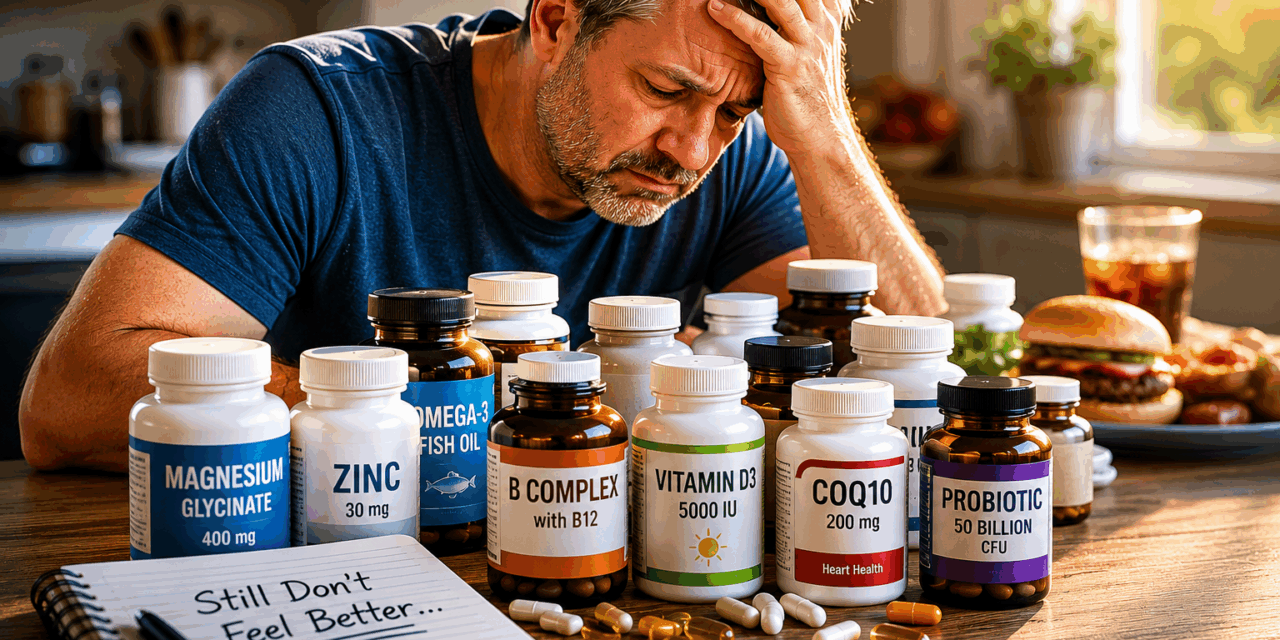
You could find yourself taking a multiple, extra zinc and magnesium, a probiotic, essential fatty acids, CoQ10 (because you read it helps blood pressure), red rice yeast, and maybe a couple of things you saw on TikTok videos. Your bile production becomes sluggish, so you add vitamins A, D, E, and K. You start seeing stuff on the internet that describes you and offers easy solutions. You end up taking a bucketful of pills. Unfortunately, they usually only produce marginal results.
The HARD Part Is Knowing How to Take Less Than a Crateload of Pills
Supplements are not drugs. Symptoms are not the problem—they are clues. Sure, sometimes you can find something that makes you feel better. Unfortunately, many times it is like putting a Band Aid on a chancre. DGL may give you relief from your reflux, but if you are not producing enough stomach HCl and your bile is thickening, you really haven’t fixed anything.
Restoring Health Is Like Peeling an Onion
If magnesium helps you with your insomnia, by all means take it. You should, however, be aware of the systems that are at the root of the problem. If you wake up in the middle of the night, you may need to get cortisol under control. You may need to do something about insulin insensitivity. Look for underlying causes.
Restore Your Health & Move On (If You Want To)
Be strict until you feel better: Dietary advice often produces despair in patients. Most absolutely love something that is not good for them. It’s ok, once your health is restored, you can cheat.
I see a lot of people who can be described as “just plain sick”. They have been to multiple doctors and not gotten answers. These people usually have multiple systems that do not function well. They may have digestion/microbiome problems, thyroid issues, cortisol issues, multiple nutrient deficiencies. In a medical system that focuses on symptoms, these folks confuse doctors.
Dietary changes must be strict at first. Consistency pays off. Most of these patients, at some point, will come in the office and say something like, “I had birthday cake at a party, and I am ok.” It takes time to get to that point, but most people get there. The trick is to not fall back into old habits, but the occasional transgression is well tolerated.
Diet: Healing NOT Lifestyle
Junk food is addictive and we need to change our diets. Most of us don’t need to adhere to a strict philosophy when it comes to diet. You should, however, make obvious changes. Here are a few things all dietary gurus will agree on:
- Avoid refined sugar
- Avoid refined grains
- Avoid chemical additives and processed foods (including heat/chemical extracted oils)
- Eat real food: If it comes in a bottle, box, or a can, it probably is not good for you. Similarly, if it was not available 10,000 years ago, it probably is not good for you.
Dietary advice creates confusion for most people. What is the right diet? Answer: there isn’t one. Each has its own strengths and weaknesses. The good news is that you don’t have to choose one and ignore the others. Think instead of what your body needs at the moment. Here are some popular diets:
- The Roadmap to Health: This is the diet I like to recommend. Its strengths are that by avoiding complex carbohydrates (there are 2 versions—one is for IBD sufferers), it helps improve the microbiome. Not that complex carbohydrates are “bad” but most of us eat too many of them and avoiding them helps digestion and the microbiome. It also recommends that 75% of the diet (by volume) be fresh produce. This makes it a powerful tool for reducing inflammation and improving the health and diversity of the microbiome. It is not perfect—no single diet is. It does not address lectins or FODMAPs, which can be a problem for some people. Sometime the amount of fiber is too much—especially for people suffering from IBD.
- The Mediterranean Diet: Medicine is falling in love with this. Great for people with insulin insensitivity, high blood pressure or heart disease. This diet will reduce inflammation. The downside is that if you have celiac, gluten sensitivity, or lactose intolerance, the diet will cause problems for you.
- Ketogenic Diet: This is very effective for people with insulin insensitivity. Also useful for people who get seizures. Most Americans will feel wonderful when following it because as a people, we eat too much carbohydrate. The downside is that people following it do not get enough vegetables. We need fiber and you tend not to get it on this diet. The polyphenols and fiber in vegetables reduce inflammation and help you develop a healthy microbiome–none of this is addressed by the diet.
- The Paleo Diet: It is based on the idea that we were healthier as hunter gatherers and that settling down and farming set us up for chronic health problems. No complex carbs are allowed (like in the Roadmap to Health), so it tends to be good for people with digestive issues. The problem is that nothing is said about vegetables, so many people following it are not getting enough fiber and would benefit from more polyphenols. Vegetables are not “forbidden” but ignored. Followers tend to eat a lot of meat and not much produce.
- Vegan: Vegans are either the healthiest people you’ve ever seen, or the sickest. In a planet as polluted as ours, eating at the bottom of the food chain makes sense. Also, it is high in fiber and polyphenols—very good for the microbiome. Unfortunately, many vegans fill up on starch and do not enjoy the digestive benefits of eating a lot of vegetables. They tend to have deficiencies of zinc, vitamin B12, and sulfur containing amino acids (to name a few). Many don’t get enough protein or eat incomplete protein. There are eight essential amino acids. Meat contains all of them vegetable protein usually does not (with the exception of quinoa). Vegans need to be mindful of where they are getting their essential nutrients. It can be a great diet–IF you know what you are doing.
A “good” food can be bad for you: Food sensitivity, although not well-researched, is a real problem. Dr. Arthur Coca focused on this in the 1960s. Personally, I have found that when you identify and remove a problem food it can really help some patients. A vegan who is sensitive to soy, for example, may not respond to any treatment until the soy is removed from the diet. It’s not the diet’s fault–it is just missing a key physiologic fact in that particular individual. I knew someone who could do nothing to improve her osteoporosis only to find out she had celiac disease and it was keeping everything else from working.
We can tolerate a lot: The American diet has been horrible for several decades, but only recently has life expectancy gone down. This means we can tolerate “bad” foods to a certain extent. Diet can heal—literally. If you have symptoms, get strict. It does not have to be forever, just until you are happy with the way you feel. After that, the occasional “forbidden” food is ok.
Supplementation—Remember Supplementation?
This article started as a discussion about supplementation. Then, it started talking about diet. The point is that if you are mindful and strict with your food choices, you can get good results with less supplementation than someone who eats “whatever”. That is the reason the “Camel’s Back” series was created. All the articles recommend some supplementation, but not every possible supplement that can help. By focusing on diet, the articles in this series can help you find a way to feel better with minimal supplementation.
The goal is not to spend the rest of your life swallowing handfuls of pills. The goal is to restore function, reduce the burden on your system, and eventually need less intervention—not more.
Frequently Asked Questions
Why don’t supplements work for some people?
Supplements can help, but they are not magic. Many people have multiple systems that are not functioning well at the same time—poor digestion, blood sugar problems, inflammation, microbiome disruption, sluggish bile production, stress hormone imbalance, and nutrient deficiencies. Taking one supplement while ignoring the underlying issues often produces disappointing results.
Are symptoms the real problem?
Usually not. Symptoms are clues. Reflux, fatigue, insomnia, headaches, IBS, brain fog, and high blood pressure are often signs that something deeper is not functioning properly. Suppressing symptoms without addressing the underlying dysfunction may provide temporary relief, but it rarely restores health.
Why do people end up taking so many supplements?
Modern life pushes people in that direction. Processed food, refined sugar, poor sleep, stress, environmental chemicals, and digestive problems all increase nutrient needs. People often add supplements one at a time as new symptoms appear, eventually ending up with a “crateload of pills” instead of a coherent plan.
What does “supplements are not drugs” mean?
Drugs are generally designed to suppress symptoms or alter physiology directly. Nutrients work differently. Magnesium does not “treat insomnia” the way a sleeping pill does. Magnesium helps correct magnesium deficiency, and that deficiency may be contributing to poor sleep. The goal is to restore normal function.
What does “peeling the onion” mean?
Health problems are often layered. You may improve one issue only to uncover another beneath it. For example, magnesium may help sleep, but the real problem could involve cortisol imbalance, insulin insensitivity, poor digestion, or inflammation. Restoring health usually requires addressing multiple underlying systems over time.
Is there one perfect diet?
No. Every diet has strengths and weaknesses. A Mediterranean diet may help insulin insensitivity and inflammation. A ketogenic diet may help blood sugar control. A vegan diet may increase fiber and polyphenols. The key is understanding what your body needs at a particular moment rather than treating any dietary philosophy like a religion.
Do I have to stay strict forever?
Usually not. Many people need to be very strict temporarily while restoring health. Once digestion improves, inflammation decreases, and the body becomes more resilient, occasional “cheating” is often tolerated much better. The goal is long-term function and flexibility—not living in fear of food forever.
Can diet really reduce the need for supplements?
Absolutely. When people improve digestion, stabilize blood sugar, reduce inflammation, and remove foods that aggravate their system, they often feel dramatically better with far less supplementation. The goal should not be to collect more pills. The goal should be to restore function so the body needs less support over time.







