
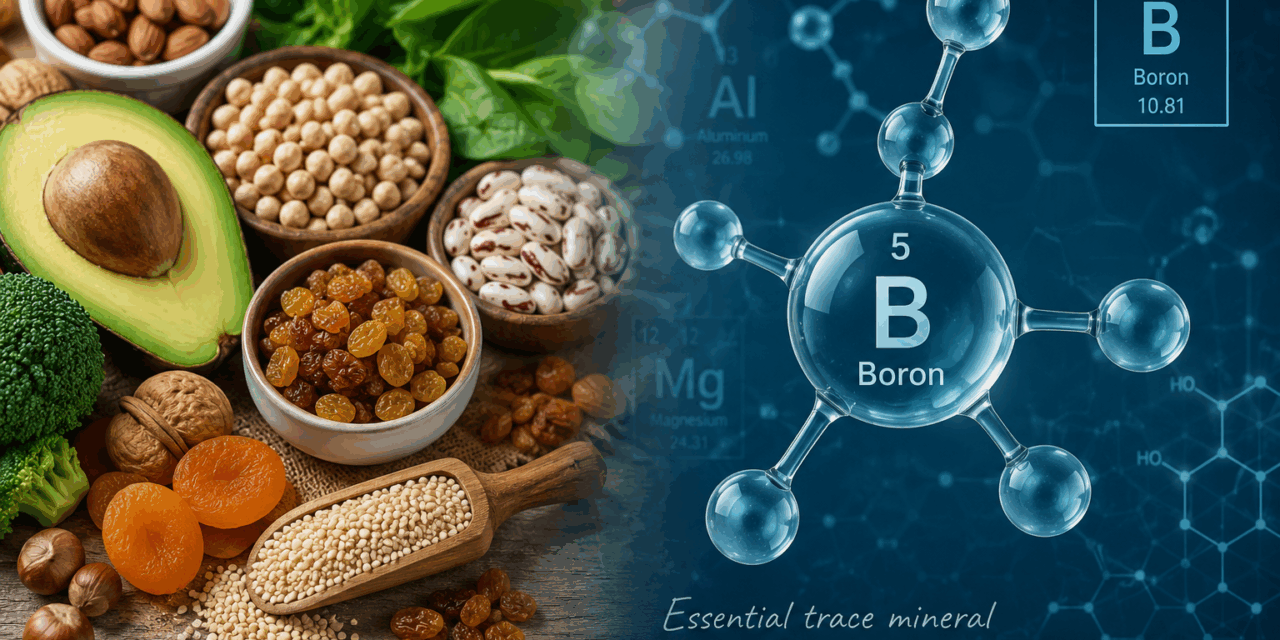
Boron is a trace mineral that most people have never heard of, yet research suggests it may influence bone strength, hormone balance, inflammation, vitamin D activity, wound healing, and even healthy aging.
Although boron is not discussed very often in mainstream medicine, researchers have been studying it for decades. Evidence suggests that low boron intake may affect bone metabolism, inflammatory pathways, and steroid hormone activity.
Boron and Osteoporosis
Boron appears to play an important role in bone growth, repair, and mineralization. Animal studies have shown that boron deficiency negatively affects bone formation and healing, while boron supplementation improves bone regeneration [1,2,3].
Researchers believe boron may influence bone metabolism through several mechanisms. Boron has been shown to affect osteoblast activity (the cells responsible for building bone) and may regulate genes involved in tissue mineralization. It also appears to interact with hormones important for skeletal health, including vitamin D, estrogen, and testosterone [4].
According to one researcher, “Boron was determined to induce mineralization of osteoblasts by regulating the expression of genes related to tissue mineralization and the actions of key hormones involved in bone growth and turnover” [4].
These findings suggest that boron may be more important to long-term bone health than previously recognized.
Boron and Wound Healing
Boron has been shown to significantly improve wound healing. In one study, application of a 3% boric acid solution to deep wounds reduced the time required in intensive care by nearly two-thirds [5].
Researchers believe boron may support tissue repair by influencing fibroblast activity. Fibroblasts are cells responsible for producing collagen and the extracellular matrix, both of which are essential for wound healing. Boron appears to affect several enzymes involved in tissue remodeling and repair, including collagenase, elastase, and alkaline phosphatase [6,7].
These findings suggest that boron may help support the body’s natural healing processes at the cellular level.
Boron and Sex Hormones
One reason researchers became interested in boron is its apparent effect on steroid hormones. Boron supplementation has been shown to increase levels of estradiol (E2) and testosterone in both men and postmenopausal women, particularly in individuals with lower magnesium intake [8].
In one study involving postmenopausal women consuming a low-magnesium diet, estradiol levels nearly doubled following boron supplementation, increasing from an average of 21.1 pg/mL to 41.4 pg/mL [8]. The same study also found substantial increases in testosterone levels, along with reductions in inflammatory cytokines [8].
Boron may also influence hormone activity by affecting sex hormone-binding globulin (SHBG), a protein that binds testosterone in the bloodstream. Because only unbound “free” testosterone is biologically active, elevated SHBG levels can reduce testosterone availability, particularly in aging men. Boron supplementation has been shown to increase free testosterone levels, which may help counteract the age-related decline in bioavailable testosterone [9,10].
These findings suggest that boron may influence both hormone production and hormone availability.
Boron and Vitamin D
Boron may help explain why some individuals do not respond well to vitamin D supplementation. Studies in both animals and humans have shown that boron supplementation can increase serum levels of 25-hydroxyvitamin D3 (25[OH]D3), the primary circulating form of vitamin D measured in blood tests [11-14].
Researchers believe boron may influence vitamin D metabolism by slowing the breakdown of vitamin D within the body. In a paper published in Medical Hypotheses, Miljkovic et al proposed that boron suppresses the activity of 24-hydroxylase, an enzyme involved in the catabolism of 25(OH)D3 [15].
If correct, this mechanism could help explain why boron appears to enhance vitamin D status in some individuals.
Boron and Inflammation
Research suggests that boron may have significant anti-inflammatory effects. Supplementation has been shown to reduce several inflammatory biomarkers associated with chronic disease and aging, including C-reactive protein (CRP), tumor necrosis factor alpha (TNF-α), and interleukin-6 (IL-6) [15-17].
In one study, one week of boron supplementation (10 mg/day) reduced TNF-α levels by approximately 20% and lowered hs-CRP and IL-6 levels by nearly 50% [15]. Another study found that 15 days of supplementation with calcium fructoborate reduced multiple inflammatory markers, including CRP, fibrinogen, and erythrocyte sedimentation rate (ESR), while no such improvements were seen in the placebo group [24].
These findings suggest that boron may influence inflammatory pathways involved in arthritis, aging, and other chronic inflammatory conditions.
Boron and Osteoarthritis
Several lines of evidence suggest that boron may play a role in joint health and osteoarthritis (OA). Epidemiological studies, tissue analyses, animal research, and human clinical trials have all linked higher boron intake with lower rates of osteoarthritis [18-20].
Researchers examining boron intake around the world observed striking differences in arthritis prevalence. In regions where boron intake is typically 1 mg/day or less, the estimated incidence of arthritis ranges from 20% to 70%. In contrast, in areas where boron intake is commonly between 3 and 10 mg/day, arthritis rates are estimated to range from 0% to 10% [21].
Additional support for boron’s role in joint health comes from tissue studies showing lower boron concentrations in the bones and synovial fluid of patients with osteoarthritis compared with individuals without OA [22].
Human clinical evidence was provided by a double-blind, placebo-controlled Australian trial in patients with osteoarthritis. In the study, 50% of subjects receiving 6 mg of boron daily improved, compared with only 10% in the placebo group [23].
Taken together, these findings suggest that boron may influence both joint structure and inflammatory processes involved in osteoarthritis.
Boron, Oxidative Stress, and Environmental Chemicals
Research suggests that boron may help protect tissues from oxidative stress caused by environmental chemicals and toxins. In one animal study, boron protected rats chronically exposed to malathion, a widely used pesticide known to increase oxidative stress, even at relatively low levels of exposure [25].
Boron supplementation reduced lipid peroxidation, restored antioxidant enzyme activity, and helped regenerate damaged liver, kidney, and brain tissue in exposed animals [25]. These findings suggest that boron may help support the body’s natural antioxidant defense systems.
Additional laboratory studies have found that boron compounds may reduce genetic damage caused by exposure to certain heavy metals [26,27].
Although more human research is needed, these findings raise interesting questions about boron’s potential role in protecting tissues from environmental stressors.
Boron and Cancer Research
Researchers have become interested in boron because populations consuming boron-rich diets, or living in regions with higher boron levels in soil and water, tend to have lower rates of certain cancers, including prostate, breast, cervical, and lung cancers. Observational studies have reported inverse associations between boron intake and cancer risk, particularly for prostate cancer [28-31].
Laboratory studies suggest that boron-containing compounds may influence cancer cell biology through multiple mechanisms. These include effects on cell division, enzyme activity, cellular signaling, and apoptosis (programmed cell death) [28].
Dietary boron intake has been found to be inversely correlated with prostate cancer incidence [29]. In addition, boric acid has been shown to inhibit the proliferation of human prostate cancer cells in vitro [30,31].
Although these findings are intriguing, much of the research remains experimental, and more human studies are needed to better understand boron’s potential role in cancer prevention.
Boron and Important Biomolecules
Some of boron’s most intriguing effects may involve its interaction with important biomolecules involved in energy production, cellular signaling, and healthy aging.
Boron influences the formation and activity of compounds known as boroesters in biomolecules containing cis-hydroxyl groups. These include ribose-containing compounds such as S-adenosyl methionine (SAM-e), diadenosine phosphates, and nicotinamide adenine dinucleotide (NAD+) [32,33]. These molecules play essential roles in numerous biochemical processes throughout the body.
Researchers have found that boron strongly binds oxidized NAD+ [34], suggesting that it may influence pathways involving ATP production, calcium signaling, and the activity of sirtuins, which are proteins associated with cellular repair and healthy aging [35].
Some researchers have proposed that boron’s effects on NAD+ metabolism may help support cellular resilience and longevity. Although this area of research is still emerging, it highlights the possibility that boron may influence human physiology at a much deeper biochemical level than previously recognized.
Conclusion
Although boron receives far less attention than minerals such as calcium, magnesium, or zinc, research suggests it may play a surprisingly broad role in human physiology. Studies have linked boron to bone metabolism, hormone regulation, vitamin D activity, inflammatory balance, wound healing, joint health, and cellular signaling pathways associated with healthy aging.
Many of these findings are preliminary, and some areas remain controversial or incompletely understood. However, the breadth of boron’s biological effects suggests that it may be far more important to human health than previously believed.
Modern diets low in fruits, vegetables, nuts, and other whole foods may also provide less boron than traditional diets, raising questions about whether suboptimal boron intake could contribute to long-term health problems in some individuals.
While boron is not a miracle nutrient, the research surrounding this overlooked trace mineral is both extensive and intriguing.
Selected References:
- Angle Orthod (2009) 79 (5): 984–990. Stimulation of Bone Formation by Dietary Boron in an Orthopedically Expanded Suture in Rabbits
- J Trace Elem Med Biol. 2009;23(3):195-203. Boron and fish oil have different beneficial effects on strength and trabecular microarchitecture of bone
- Environ Health Perspect. 1994 Nov;102 Suppl 7(Suppl 7):35-43. The biochemical effects of physiologic amounts of dietary boron in animal nutrition models
- J Trace Elem Med Biol. 2010 Oct;24(4):243-50. Boron regulates mineralized tissue-associated proteins in osteoblasts (MC3T3-E1)
- Presse Med. 1990 Jun 2;19(22):1050-2. [Treatment of deep wounds with loss of tissue. Value of a 3 percent boric acid solution]
- J Trace Elem Med Biol. 2000 Oct;14(3):168-73. Effects of boron derivatives on extracellular matrix formation
- J Trace Elem Med Biol. 2002;16(4):239-44. Mechanisms implicated in the effects of boron on wound healing
- J Trace Elem Med Biol. 2011 Jan;25(1):54-8 Comparative effects of daily and weekly boron supplementation on plasma steroid hormones and proinflammatory cytokines
- Morgentaler A. Testosterone for Life: Recharge Your Vitality, Sex Drive, Muscle Mass, and Overall Health. New York, NY: McGraw-Hill; 2009. p. 65.
- J Androl. Sep-Oct 2012;33(5):817-23 The comparison of the aging male symptoms (AMS) scale and androgen deficiency in the aging male (ADAM) questionnaire to detect androgen deficiency in middle-aged men
- Environ Health Perspect. 1994;102(suppl 7):55–58. Effects of dietary boron in rats fed a vitamin D-deficient diet.
- Environ Health Perspect. 1994 Nov;102 Suppl 7(Suppl 7):35-43. The biochemical effects of physiologic amounts of dietary boron in animal nutrition models
- J Trace Elem Exp Med. 1990;3:45–54. Effect of boron depletion and repletion on blood indicators of calcium status in humans fed a magnesium-low diet
- J Diet Suppl. 2009;6(3):211–226. Calcium fructoborate: plant-based dietary boron for human nutrition.
- J Trace Elem Med Biol. 2011;25(1):54–58. Comparative effects of daily and weekly boron supplementation on plasma steroid hormones and proinflammatory cytokines
- 2000;16(7–8):512–51 The emergence of boron as nutritionally important throughout the life cycle.
- J Anim Sci. 2003;81(10):2552–2561. Effect of boron supplementation of pig diets on the production of tumor necrosis factor-alpha and interferon-gamma.
- Newnham RE. Essentiality of boron for healthy bones and joints. Environ Health Perspect. 1994;102(suppl 7):83–85.
- Newnham R. Discovering the cure for arthritis. Nutr Health. 2004;17(4):281–284
- Scorei R, Mitrut P, Petrisor I, Scorei I. A double-blind, placebo-controlled pilot study to evaluate the effect of calcium fructoborate on systemic inflammation and dyslipidemia markers for middle-aged people with primary osteoarthritis. Biol Trace Elem Res. 2011;144(1–3):253–263.
- Korkmaz M, Sayli U, Sayli BS, et al. Estimation of human daily boron exposure in a boron-rich area. Br J Nutr. 2007;98(3):571–575.
- Helliwell TR, Kelly SA, Walsh HP, et al. Elemental analysis of femoral bone from patients with fractured neck of femur or osteoarthrosis. Bone. 1996;18(2):151–157.
- Travers RL, Rennie GC, Newnham RE. Boron and arthritis: the results of a double-blind pilot study. J Nutr Environ Med. 1990;1(2):127–132.
- Scorei R, Mitrut P, Petrisor I, Scorei I. A double-blind, placebo-controlled pilot study to evaluate the effect of calcium fructoborate on systemic inflammation and dyslipidemia markers for middle-aged people with primary osteoarthritis. Biol Trace Elem Res. 2011;144(1–3):253–263.
- Coban FK, Ince S, Kucukkurt I, Demirel HH, Hazman O. Boron attenuates malathion-induced oxidative stress and acetylcholinesterase inhibition in rats. Drug Chem Toxicol [published online ahead of print October 24, 2014]
- Turkez H, Geyikoglu F, Tatar A, Keles MS, Kaplan I. The effects of some boron compounds against heavy metal toxicity in human blood. Exp Toxicol Pathol. 2012;64(1–2):93–101.
- J Appl Toxicol. 2008 Jul;28(5):658-64 Effects of boric acid and borax on titanium dioxide genotoxicity
- Scorei RI, Popa R., Jr Boron-containing compounds as preventive and chemotherapeutic agents for cancer. Anticancer Agents Med Chem. 2010;10(4):346–351.
- Cui Y, Winton MI, Zhang ZF, et al. Dietary boron intake and prostate cancer risk. Oncol Rep. 2004;11(4):887–892
- Gallardo-Williams MT, Maronpot RR, Wine RN, Brunssen SH, Chapin RE. Inhibition of the enzymatic activity of prostate-specific antigen by boric acid and 3-nitrophenyl boronic acid. Prostate. 2003;54(1):44–49.
- Barranco WT, Eckhert CD. Boric acid inhibits human prostate cancer cell proliferation. Cancer Lett. 2004;216(1):21–29.
- Nielsen FH. Update on human health effects of boron. J Trace Elem Med Biol. 2014;28(4):383–387.
- Bolaños L, Lukaszewski K, Bonilla I, Blevins D. Why boron? Plant Physiol Biochem. 2004;42(11):907–912.
- Ralston NV, Hunt CD. Diadenosine phosphates and S-adenosylmethionine: novel boron binding biomolecules detected by capillary electrophoresis. Biochim Biophys Acta. 2001;1527(1–2):20–30.
- Mouchiroud L, Houtkooper RH, Auwerx J. NAD+ metabolism: a therapeutic target for age-related metabolic disease. Crit Rev Biochem Mol Biol. 2013;48(4):397–408





