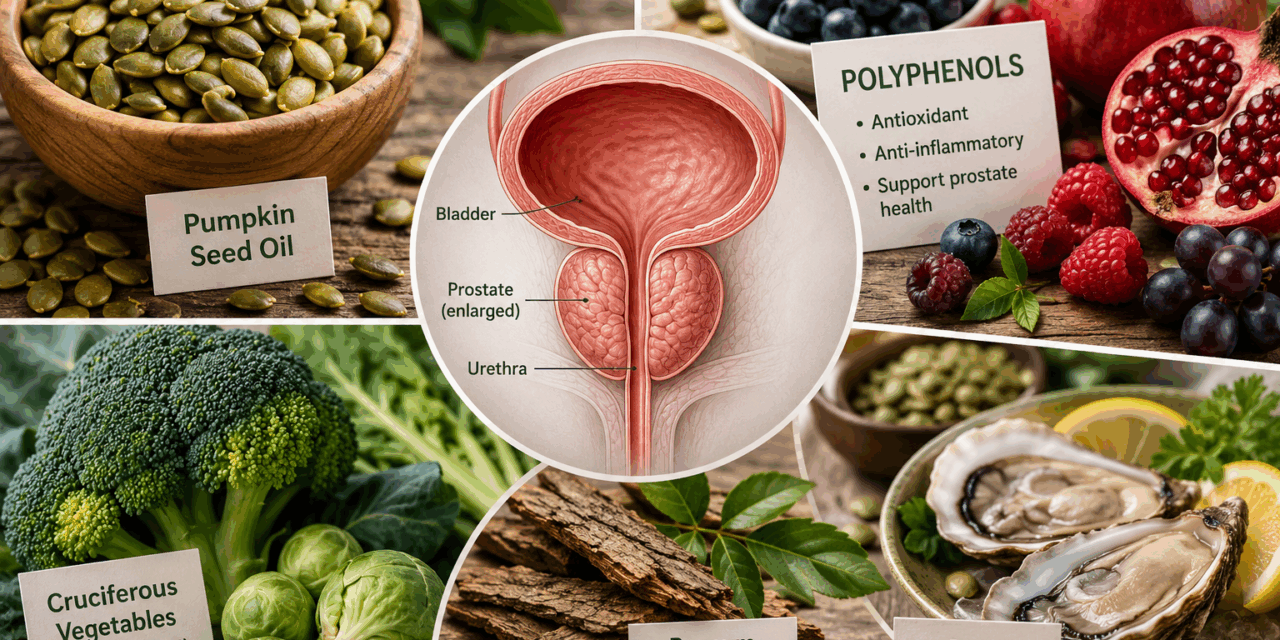
This article is going to review some studies and present some ideas clinicians have for shrinking the prostate for men with BPH (benign prostatic hypertrophy). Prostate cancer is another animal, and you should be discussing that with your physician.
Inflammation and the Prostate:
Although BPH is often viewed as a hormonal condition, chronic inflammation is commonly found in enlarged prostate tissue. Many of the nutrients and herbs discussed below have anti-inflammatory effects in addition to their direct effects on prostate tissue. As you go through the list, it may strike you that many of the substance studied are polyphenols, which among other things, can reduce inflammation. One of the best ways to reduce inflammation is with diet. Roadmap to Health is a diet that can reduce inflammation.
Saw Palmetto and the Prostate:
Whenever you talk about natural approaches for BPH, saw palmetto invariably comes up. Unfortunately, when studied as a sole treatment for BPH, it does not do much better than placebo [1].
BPH and Pumpkin Seed Oil
The polyphenols in pumpkin seed oil are powerful anti-inflammatories. These include caffeic acid, vanillic acid, ferulic acid, PHBA, sinapic acid, and p-coumaric acid. The best-studied benefit of pumpkin seed oil is prostate health [2-5]. It was compared to tamsulosin for patients with BPH. The International Prostate Symptom Score (IPSS) was filled out by the patients at baseline and then 1 month and 3 months after the initiation of treatment. For the first 3 months, the patients taking the pumpkin seed oil fared better than those on the drug. After 3 months, the drug group fared better. None of the patients in the pumpkin group experienced drug side effects, while dizziness, headache, retrograde ejaculation, and erythema with pruritus occurred in the tamsulosin group [5].
DIM and Hormonal Influences on Prostate Health
Research indicates DIM (Diindolylmethane) supports prostate health by modulating sex hormones, curbing inflammation, and inhibiting tumor cell growth. It has lowered PSA in case studies [13].
Diindolylmethane and chrysin are aromatase inhibitors. Diindolylmethane helps protect against feminizing cancers because of its effect on estrogen metabolism. It creates an increase in the ratio of 2-hydroxyestrones (C-2) to 16α-hydroxyestrone (C-16), consistent with antiestrogenic activity [3,4]. In vitro studies have shown that DIM inhibits proliferation of both breast [5] and prostate cancer cells [9-15].
Beta-Sitosterol and Nighttime Urination
Beta-Sitosterol is a naturally occurring plant sterol (phytosterol) with a chemical structure similar to cholesterol. It is antioxidant and anti-inflammatory. It is frequently used to alleviate urinary symptoms associated with benign prostatic hyperplasia (BPH) or an enlarged prostate. It improves urinary flow and reduces discomfort [16-18]. Beta sitosterol has also been studied in combination with saw palmetto and other antioxidants and found to be effective for BPH symptoms [19,20].
Pygeum Africanum for Benign Prostatic Hyperplasia
Extracted from the bark of the African plum tree, a comprehensive Cochrane systematic review (A total of 18 randomized controlled trials involving 1562 men met inclusion criteria and were analyzed) on Pygeum concluded that it is well-tolerated and provides significant, moderate relief from urinary issues [23].
Other Helpful Hints and Nutrients:
Iodine: In patients with early BPH (Grade I and II), iodine supplementation decreased the prostate-specific antigen (PSA) circulating levels and improved the urinary flow and symptoms scale [21]. These studies agree with epidemiological data that associate the low incidence of breast and prostate pathologies with the moderately high dietary intake of iodine in Asian countries. Iodine is mentioned here because a number of clinicians see it as a key nutrient for BPH. Some clinicians use high doses of iodine for patients with prostate issues.
Zinc: In prostate carcinoma, the mean tissue zinc was decreased by 83% as compared to normal tissue and in BPH, there was a 61% decrease in mean tissue zinc as compared to normal tissues. The plasma zinc in prostate cancer patients showed a 27% decrease as compared to controls and 18% decrease as compared to BPH. The urine zinc/creatinine (ratio) was significantly increased to 53% in prostate cancer patients, and a 20% significant increase was observed in BPH as compared to normal subjects [22].
Superoxide Dismutase: There are studies that show this powerful antioxidant to be good for BPH and for possibly preventing prostate cancer [24]. It is mentioned here because some clinicians find it to be a vital part of their protocols for prostate health.
Putting It All Together
There is probably no single cause of BPH. Hormones play a role, but so do inflammation, oxidation, and nutritional deficiencies. That may explain why no single supplement works for everyone.
The common thread running through many of the studies reviewed here is inflammation. Pumpkin seed oil, beta-sitosterol, pygeum, DIM, zinc, iodine, and superoxide dismutase all have anti-inflammatory or antioxidant properties. They may also influence hormones, cellular growth, or prostate function through other mechanisms.
Many clinicians find that the best results occur when prostate-specific nutrients are combined with an anti-inflammatory diet and a broader effort to improve overall health. Rather than asking, “What supplement shrinks the prostate?” a better question may be, “What factors are causing the prostate to enlarge in the first place?”
Selected References:
- Cochrane Review 22 June 2023 Serenoa repens for benign prostatic hyperplasia
- Urol Int. 2015;94(3):286-95. Effects of pumpkin seed in men with lower urinary tract symptoms due to benign prostatic hyperplasia in the one-year, randomized, placebo-controlled GRANU study
- Nutr Res Pract. 2009 Winter;3(4):323-327 Effects of pumpkin seed oil and saw palmetto oil in Korean men with symptomatic benign prostatic hyperplasia
- Med. Food, 9 (2006), pp. 284-28 Inhibition of testosterone-induced hyperplasia of the prostate of sprague-dawley rats by pumpkin seed oil
- BMC Urol. 2021 Oct 19;21(1):147 Pumpkin seed oil (Cucurbita pepo) versus tamsulosin for benign prostatic hyperplasia symptom relief: a single-blind randomized clinical trial
- Thyroid 2011 Mar; 21(3): 299–304. 3,3′-Diindolylmethane Modulates Estrogen Metabolism in Patients with Thyroid Proliferative Disease: A Pilot Study
- Nutr Cancer. 2023;75(2):510-519. Effectiveness of 3,3′-Diindolylmethane Supplements on Favoring the Benign Estrogen Metabolism Pathway and Decreasing Body Fat in Premenopausal Women
- J Environ Pathol Toxicol. 1980 Mar;3(4 Spec No):35-52. Inhibitors of chemical carcinogens
- J Cell Biochem. 2009 Jun 1;107(3):516-27. doi: 10.1002/jcb.22152. Inactivation of uPA and its receptor uPAR by 3,3′-diindolylmethane (DIM) leads to the inhibition of prostate cancer cell growth and migration
- Oncogene 2001 May 24;20(23):2927-36. Indole-3-carbinol (I3C) induced cell growth inhibition, G1 cell cycle arrest and apoptosis in prostate cancer cells
- Clin Cancer Res. 2002 Apr;8(4):1228-36 Akt inactivation is a key event in indole-3-carbinol-induced apoptosis in PC-3 cells.
- J Nutr. 2008 Dec;138(12):2379–2385. doi: 10.3945/jn.108.090993 3,3′-Diindolylmethane and Genistein Decrease the Adverse Effects of Estrogen in LNCaP and PC-3 Prostate Cancer Cells
- Altern Ther Health Med. 2026 Jan;32(1):56-59. DIM and PSA Reduction: Blocking Aromatization for Prostate Health: A Case Report
- J Biomed Res. 2014 Apr 20;28(5):339–348. doi: 10.7555/JBR.28.20140008 Multiple therapeutic and preventive effects of 3,3′-diindolylmethane on cancers including prostate cancer and high grade prostatic intraepithelial neoplasia
- Int J Mol Sci. 2023 Feb 11;24(4):3620. doi: 10.3390/ijms24043620 The Plant Derived 3-3′-Diindolylmethane (DIM) Behaves as CB2 Receptor Agonist in Prostate Cancer Cellular Models
- Br J Urol. 1997 Sep;80(3):427-32. A multicentric, placebo-controlled, double-blind clinical trial of beta-sitosterol (phytosterol) for the treatment of benign prostatic hyperplasia. German BPH-Phyto Study group
- 1995 Jun 17;345(8964):1529-32. doi: 10.1016/s0140-6736(95)91085-9. Randomised, placebo-controlled, double-blind clinical trial of beta-sitosterol in patients with benign prostatic hyperplasia. Beta-sitosterol Study Group
- BJU Int. 2000 May;85(7):842-6. doi: 10.1046/j.1464-410x.2000.00672.x. Treatment of symptomatic benign prostatic hyperplasia with beta-sitosterol: an 18-month follow-up
- Int Urol Nephrol. 2001;33(2):217-25. doi: 10.1023/a:1015227604041. Randomized trial of a combination of natural products (cernitin, saw palmetto, B-sitosterol, vitamin E) on symptoms of benign prostatic hyperplasia (BPH)
- BMC Urol. 2020 Jul 3;20(1):86. A double blind, placebo-controlled randomized comparative study on the efficacy of phytosterol-enriched and conventional saw palmetto oil in mitigating benign prostate hyperplasia and androgen deficiency
- Therapeutic effect of iodine on human benign prostatic hyperplasia. In Proceedings of the 14th International Thyroid Congress, Paris, France, 11–16 September 2010.
- Indian J Urol. 2011 Jan-Mar;27(1):14–18. Zinc status of patients with benign prostatic hyperplasia and prostate carcinoma
- Cochrane Database Syst Rev. 1998 Jan 26;1998(1):CD001044. Pygeum africanum for benign prostatic hyperplasia
- Anticancer Research June 2014, 34 (6) 2821-2831; SOD3 Acts as a Tumor Suppressor in PC-3 Prostate Cancer Cells via Hydrogen Peroxide Accumulation