Berberine: One of the Best-Researched Supplements for Metabolic Health
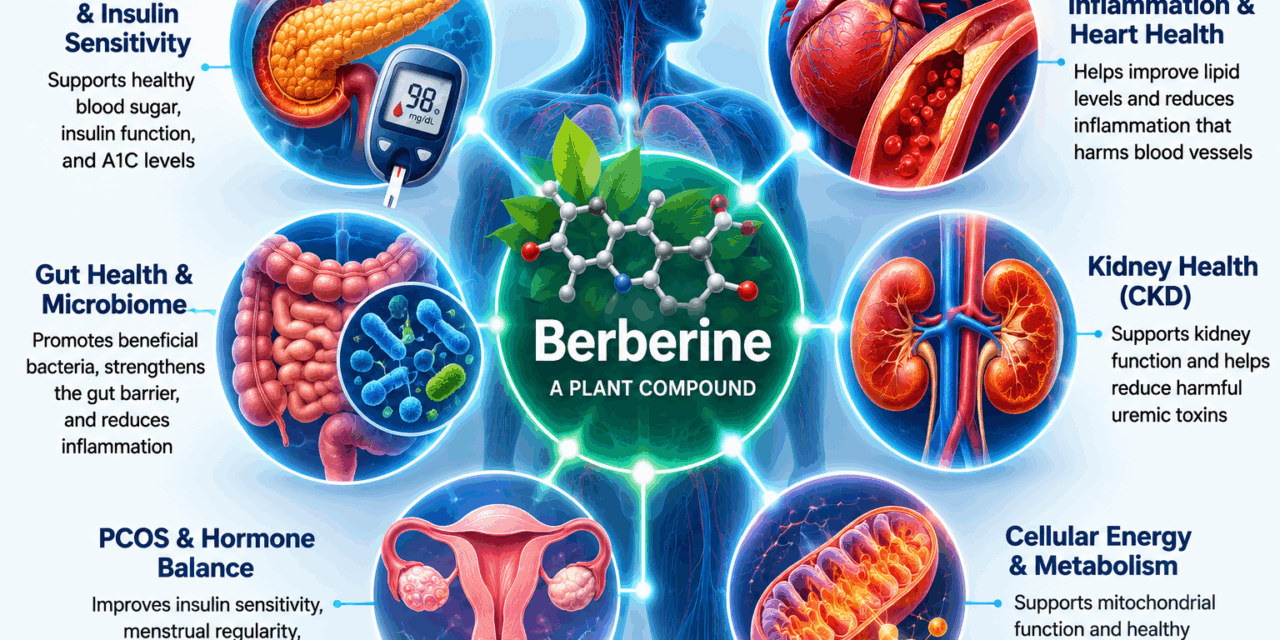
Berberine is one of the most extensively studied plant compounds in nutritional medicine. Although it is best known for helping support healthy blood sugar levels, researchers have also investigated it for high cholesterol, chronic inflammation, gut health, chronic kidney disease, polycystic ovary syndrome (PCOS), and many other conditions.
Why has one plant compound attracted so much scientific interest? The answer is that many chronic diseases share common underlying problems—including insulin resistance, chronic inflammation, changes in the gut microbiome, and impaired cellular energy metabolism. Berberine appears to influence several of these core processes, helping explain why it continues to be studied across such a wide range of health conditions.
Berberine for Insulin Insensitivity and Type 2 Diabetes
Berberine has been well researched and shown to reduce blood sugar and A1C. Studies have shown that Berberine can help and that Berberine performs similarly to metformin. Subjects have had significant decreases in A1C, fasting blood glucose, postprandial blood glucose, and plasma triglycerides [1-5].
Berberine is comparable to Metformin. “Berberine HCl demonstrated glycemic efficacy comparable to Metformin in prediabetic patients, with fewer gastrointestinal adverse events” [6]. Metformin is relatively inexpensive at $4-20/month. Newer diabetes medications, particularly SGLT2 inhibitors and GLP-1 receptor agonists, ostensibly help protect the heart and slow the progression of kidney disease, which is why current diabetes guidelines increasingly recommend them for high-risk patients. The newer diabetes drugs can cost hundreds or even more than $1,000 per month. This raises an interesting question: Is there a less expensive way to improve blood sugar while also supporting the heart and kidneys?
Interestingly, research suggests that Berberine may provide many of the same metabolic, cardiovascular, and kidney-supporting effects that make these newer drugs attractive—at a fraction of the cost.
Because insulin resistance plays a central role in nonalcoholic fatty liver disease (NAFLD), berberine has also been studied for its effects on fatty liver. Early research suggests it may help reduce liver fat while improving insulin sensitivity. (Click for Berberine and Fatty Liver)
Berberine and High Cholesterol
A systematic review and meta-analysis of 19 studies evaluated berberine used alone or in combination for dyslipidemia. Across controlled and observational trials, Berberine was associated with reductions in total cholesterol and LDL cholesterol, with smaller reductions in triglycerides and no statistically significant increase in HDL. The strongest lipid-lowering effects were seen when berberine was combined with silymarin, likely due to improved bioavailability, though further clinical trials are needed to better define long-term efficacy and ideal candidates for therapy [15].
Berberine, Inflammation and Blood Vessel Health
Preclinical research supports berberine’s broader cardiovascular effects. Atherosclerosis is driven not only by an unfavorable lipid profile but also by chronic vascular inflammation.
A dose–response meta-analysis of 18 randomized controlled trials involving 1,600 adults found that berberine or barberry supplementation was associated with significant reductions in IL-6, TNF-α, and CRP. Nonlinear analyses suggested that these anti-inflammatory effects were most evident at doses under 1,000 mg/day and with interventions lasting less than five weeks [16]. Multiple other systematic reviews support berberine’s ability to lower CRP and related inflammatory markers across cardiometabolic populations [17,18]. Consistent with this broader anti-inflammatory profile, berberine has also been studied as an adjunct in acute ischemic stroke, where reductions in inflammatory burden appear to translate into clinically meaningful benefits [19].
Despite the strength of CRP as a cardiovascular risk marker, it is often ignored—because there are no patentable therapies designed specifically to lower it. In contrast, cholesterol reduction remains a primary target, not because it is always the dominant driver of risk, but because it is pharmacologically addressable within the current healthcare model. This mismatch between risk biology and therapeutic incentives helps explain why inflammation-driven interventions, including nutraceuticals such as berberine, remain underutilized despite a growing evidence base.
Berberine and CKD
Supplementing patients with chronic kidney disease (CKD) is conditional. Depending on the stage, medication being used and other factors, what is good for one group of patients may not be good for others. According to animal and laboratory studies, berberine also appears to have direct protective effects on kidney tissue. It reduces inflammation, oxidative stress, and fibrosis—all of which contribute to the progression of chronic kidney disease.
Berberine is generally helpful to patients in the early stages of CKD (CKD1 & 2). Because safety data in advanced CKD are limited and berberine may accumulate as kidney function declines, people with later-stage CKD should use it only under the supervision of their healthcare provider. Studies indicate that berberine balances gut microbiota. This reduces the production of harmful, gut-derived uremic toxins like p-cresol and trimethylamine N-oxide (TMAO), which otherwise burden failing kidneys. [20].
Berberine supports kidney health indirectly by helping control blood sugar, blood pressure, and cholesterol. Berberine also has direct effects on kidney tissue itself. It exerts anti-inflammatory, antioxidant, and anti-fibrotic effects on kidney tissues [21].
Berberine and Gut Health
Berberine promotes a healthier and more diverse gut microbiome by increasing beneficial bacteria—such as Akkermansia, Bifidobacterium, and Lactobacillus—while reducing bacteria associated with inflammation and metabolic dysfunction. These changes are linked with improved gut barrier integrity, increased short-chain fatty acid (SCFA) production, and better regulation of metabolic conditions such as obesity and type 2 diabetes [22-24].
Because berberine can help modulate the gut microbiome, support gastric and intestinal mucosal integrity, and reduce inflammation, it has been studied as an adjunct therapy for inflammatory bowel disease (IBD), including Crohn’s disease and ulcerative colitis. A substantial body of experimental and clinical literature supports these effects [25-32]. In practice, berberine is often combined with dietary interventions such as the Specific Carbohydrate Diet, which has been reported to induce remission in approximately 45–66% of IBD patients.
Berberine and PCOS
Avoiding sugar is a well-researched key to dealing with PCOS [33-36]. Berberine has been extensively studied for its ability to improve insulin sensitivity and support healthy blood sugar metabolism. It has also attracted considerable attention because its benefits extend beyond improving insulin sensitivity. Research suggests it may also reduce chronic inflammation, improve hormone balance, and enhance fertility in some women with PCOS.
PCOS is often associated with hyperandrogenism—higher-than-normal levels or activity of male sex hormones. These hormones contribute to acne, unwanted facial or body hair, scalp hair thinning, irregular menstrual cycles, and infertility. Clinical studies suggest that berberine may help lower excess male sex hormones and improve hormone balance in women with PCOS [8-11].
Several randomized trials and a recent meta-analysis suggest that berberine may improve ovulation and reproductive outcomes when used as an adjunct to standard care. Berberine may influence many other aspects of hormone regulation as well, but I don’t want to turn this into a chemistry lesson. If you’re interested in the underlying physiology, the research is fascinating. See references [37-45].
Selected References
- Metabolism 2008 May;57(5):712-7 Efficacy of berberine in patients with type 2 diabetes mellitus
- J Ethnopharmacol. 2015 Feb 23;161:69-81 Meta-analysis of the effect and safety of berberine in the treatment of type 2 diabetes mellitus, hyperlipemia and hypertension
- Metabolism 2010 Feb;59(2):285-92 Berberine lowers blood glucose in type 2 diabetes mellitus patients through increasing insulin receptor expression
- J Clin Endocrinol Metab. 2008 Jul;93(7):2559-65 Treatment of type 2 diabetes and dyslipidemia with the natural plant alkaloid berberine
- Metab Syndr Relat Disord. 2013 Oct;11(5):366-9 Effect of berberine administration on metabolic syndrome, insulin sensitivity, and insulin secretion
- International Journal of Basic & Clinical Pharmacology VOL. 14 NO. 5 (2025): SEPTEMBER-OCTOBER 2025 Comparative study of efficacy and safety of berberine hydrochloride versus metformin in newly diagnosed prediabetic patients: a randomized clinical trial
- N Engl J Med February 7, 2002;346:393-403 Reduction in the incidence of type 2 diabetes with lifestyle intervention or metformin
- N Engl J Med. 2001 May 3;344(18):1343-50 Prevention of type 2 diabetes mellitus by changes in lifestyle among subjects with impaired glucose tolerance
- JAMA 2017 Aug 15;318(7):637-646 Effect of an Intensive Lifestyle Intervention on Glycemic Control in Patients With Type 2 Diabetes: A Randomized Clinical Trial
- JAMA 2012 Dec 19;308(23):2489-96 Association of an intensive lifestyle intervention with remission of type 2 diabetes
- J Clin Endocrinol Metab. 1995 Apr;80(4):1376-81 Effects of insulin on plasma magnesium in noninsulin-dependent diabetes mellitus: evidence for insulin resistance
- Nutrients 2018 Dec 26;11(1):44 The Effects of Oral Magnesium Supplementation on Glycemic Response among Type 2 Diabetes Patients
- Magnes Res. 1994 Mar;7(1):43-7 Effects of oral magnesium supplementation on plasma lipid concentrations in patients with non-insulin-dependent diabetes mellitus
- Diabetes Care. 2014 Feb;37(2):419-27 Higher magnesium intake reduces risk of impaired glucose and insulin metabolism and progression from prediabetes to diabetes in middle-aged americans
- J Med Food. 2020 Feb;23(2):101–113. Berberine and Dyslipidemia: Different Applications and Biopharmaceutical Formulations Without Statin-Like Molecules — A Meta-Analysis.
- Phytother Res. 2023 Dec;37(12):5541-5557. Effects of berberine and barberry on selected inflammatory biomarkers in adults: A systematic review and dose-response meta-analysis of randomized clinical trials
- Complement Ther Med. 2019 Oct:46:81-86. Effect of Berberine on C-reactive protein: A systematic review and meta-analysis of randomized controlled trials
- Phytother Res. 2023 Sep;37(9):3820-3838. Effects of adjuvant berberine therapy on acute ischemic stroke: A meta-analysis
- Acta Pharm Sin B. 2023 Apr;13(4):1537-1553. Berberine ameliorates chronic kidney disease through inhibiting the production of gut-derived uremic toxins in the gut microbiota
- Pharmacol., 20 February 2025 Sec. Renal Pharmacology Volume 16 – 2025 Unveiling the therapeutic potential of berberine: its therapeutic role and molecular mechanisms in kidney diseases
- Metabolism Volume 70, May 2017, Pages 72-84 Berberine-induced bioactive metabolites of the gut microbiota improve energy metabolism
- Nutrients 2021, 13(5), 1436 Prebiotic Effect of Berberine and Curcumin Is Associated with the Improvement of Obesity in Mice
- Nature Communications volume 11, Article number: 5015 (2020) Gut microbiome-related effects of berberine and probiotics on type 2 diabetes (the PREMOTE study)
- Am J Physiol Gastrointest Liver Physiol. 2011 Dec 15;302(5):G504–G514. Berberine promotes recovery of colitis and inhibits inflammatory responses in colonic macrophages and epithelial cells in DSS-treated mice
- Pharmacological Research Volume 113, Part A, November 2016, Pages 592-599 Berberine and inflammatory bowel disease: A concise review
- Front Pharmacol, 05 September 2022 Pharmacological effects of berberine on models of ulcerative colitis: A meta-analysis and systematic review of animal studies Sec. Ethnopharmacology Volume 13 – 2022 |
- BMC Biology; 02 December 2024 Berberine ameliorates dextran sulfate sodium -induced colitis through tuft cells and bitter taste signalling
- American Journal of Physiology: Gastrointestinal and Liver Physiology 01 March 2012 Berberine promotes recovery of colitis and inhibits inflammatory responses in colonic macrophages and epithelial cells in DSS-treated mice
- Biochemical and Biophysical Research Communications Volume 695, 5 February 2024, 149411 Berberine alleviates inflammation and suppresses PLA2-COX-2-PGE2-EP2 pathway through targeting gut microbiota in DSS-induced ulcerative colitis
- International digestive disease forum, Hong Kong, 2014 | AbstractVolume 13, Issue 1p215-216January 2015 Berberine Alone and in Conjunction With Immunomodulators Down-regulates Pro-inflammatory CD4+ T-Cells: Implications for a Combined Treatment of Inflammatory Bowel Diseases
- Cancer Prevention Research January 08 2020 A Phase I Trial of Berberine in Chinese with Ulcerative Colitis Free
- Scientific Reports volume 15, Article number: 42649 (2025) Insulin resistance in polycystic ovary syndrome phenotypes and the vicious cycle model in its etiology
- Endocr Rev. 1997 Dec;18(6):774-800. Insulin resistance and the polycystic ovary syndrome: mechanism and implications for pathogenesis
- Cureus 2023 Aug 31;15(8):e44493. Role of Metformin in Polycystic Ovary Syndrome (PCOS)-Related Infertility
- Explore (NY). 2024 Nov-Dec;20(6):103040. Berberine as adjuvant therapy for treating reduced fertility potential in women with polycystic ovary syndrome: A meta-analysis of randomized controlled trials
- Ginekologia Polska2024, vol. 95, no. 4, 276–284 The role of berberine in polycystic ovary syndrome — a summary of knowledge
- Wei W, Zhao H, Wang A, et al. A clinical study on the short-term effect of berberine in comparison to metformin on the metabolic characteristics of women with polycystic ovary syndrome. Eur J Endocrinol. 2012; 166(1): 99–105, doi: 10.1530/EJE-11-0616, indexed in Pubmed: 22019891.
- Li L, Li C, Pan P, et al. A Single Arm Pilot Study of Effects of Berberine on the Menstrual Pattern, Ovulation Rate, Hormonal and Metabolic Profiles in Anovulatory Chinese Women with Polycystic Ovary Syndrome. PLoS One. 2015; 10(12): e0144072, doi: 10.1371/journal.pone.0144072, indexed in Pubmed: 26645811.
- An Y, Sun Z, Zhang Y, et al. The use of berberine for women with polycystic ovary syndrome undergoing IVF treatment. Clin Endocrinol. 2013; 80(3): 425–431, doi: 10.1111/cen.12294.
- Orio F, Muscogiuri G, Palomba S, et al. Berberine improves reproductive features in obese Caucasian women with polycystic ovary syndrome independently of changes of insulin sensitivity. e-SPEN Journal. 2013; 8(5): e200–e204, doi: 10.1016/j.clnme.2013.07.002.
- Li J, Cao Bo, Liu X, et al. Berberine suppresses androgen receptor signaling in prostate cancer. Mol Cancer Ther. 2011; 10(8): 1346–1356, doi: 10.1158/1535-7163.MCT-10-0985, indexed in Pubmed: 21613449.
- Horman S, Vertommen D, Heath R, et al. Insulin antagonizes ischemia-induced Thr172 phosphorylation of AMP-activated protein kinase alpha-subunits in heart via hierarchical phosphorylation of Ser485/491. J Biol Chem. 2006; 281(9): 5335–5340, doi: 10.1074/jbc.M506850200, indexed in Pubmed: 16340011.
- Zhang SW, Zhou J, Gober HJ, et al. Effect and mechanism of berberine against polycystic ovary syndrome. Biomed Pharmacother. 2021; 138: 111468, doi: 10.1016/j.biopha.2021.111468, indexed in Pubmed: 33740526.
- Manna PR, Stetson CL, Slominski AT, et al. Role of the steroidogenic acute regulatory protein in health and disease. Endocrine. 2016; 51(1): 7–21, doi: 10.1007/s12020-015-0715-6, indexed in Pubmed: 26271515.