Could You Have a Vitamin Deficiency Without Knowing It?
When I was in school, vitamin deficiency was discussed in terms of RDAs and deficiency diseases. If you were deficient in thiamin, you got beriberi. If you did not have beriberi, you had enough thiamin. That was a long time ago, in fact, back then in my chemistry class, we were taught us about the four elements: fire, earth, air, and water.
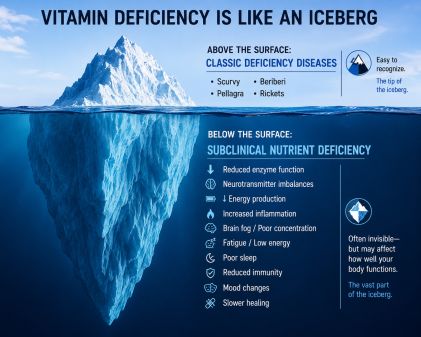
Slowly, scientists are beginning to look at vitamin deficiency differently. You can have a sub-optimal intake of a vitamin or mineral and it will affect enzyme systems and even produce symptoms.
Vitamin Deficiency Is not “All or None”
When you look at vitamin B6 through the old vitamin deficiency lens, you may come to the conclusion that vitamin B6 deficiency is extremely rare. It turns out that sub optimal intake can be linked to a number of problems. Researchers looked at this in 1984 and came up with a different way of looking at vitamin deficiency. They came up with he following conclusions:
- Deficiency is not “all or none”. You can have inadequate levels of a nutrient without being “deficient” in the traditional sense. There are optimal levels, slightly impaired, moderately impaired, severely impaired or frank deficiency disease [1].
- “Normal” isn’t necessarily optimal: Population studies may be using people with unknown degrees of deficiency as the reference population [1].
- Metabolism changes before symptoms appear. A person can be asymptomatic, but still not have adequate levels of a nutrient [1].
- The body prioritizes enzymes. When B6 intake begins to fall, not all enzymes are affected equally. The body appears to preserve the most critical functions first, while enzymes with a lower affinity for B6 become impaired earlier [1].
- RDAs are too low. The RDA tells you the amount of a nutrient necessary to avoid a frank deficiency disease—NOT the optimum amount the body needs [1].
Newer Research Supports the 1984 Paper
In 2019 researchers looked at 270 apparently “healthy” adults and found high rates of subclinical deficiencies in a number of nutrients, including B2, B6, folate, and vitamin D [2]. More than half of the participants also had elevated homocysteine, suggesting that these nutrient shortfalls were affecting metabolism, not just laboratory values [2].
Vitamins are cofactors for thousands of biochemical reactions—not just protection against scurvy or beriberi. A 2002 JAMA article discussed nutrients as not simply “deficiency preventers.” The reason subclinical deficiencies matter is simple. Vitamins don’t have one job—they participate in thousands of biochemical reactions every day [3]:
- DNA synthesis and repair
- Mitochondrial energy production
- One-carbon metabolism
- Neurotransmitter synthesis
- Myelin maintenance
- Antioxidant defense
- Immune function
- Cell signaling and gene regulation
It may be worth mentioning that testing for vitamin levels, like B12, may be inadequate and it may be more effective to look at general biochemistry and metabolism to discern nutrient deficiencies [4].
Subclinical deficiencies can lead to symptoms. A 2025 study found that people with severe chronic pain had significantly lower vitamin D, B12, and folate levels than those with less or no pain. Magnesium deficiency was also more common among those with severe pain [5]. Micronutrient deficiency in older adults is associated with chronic age-related diseases and adverse functional outcomes [6].
Vitamins Don’t Cure Disease (Except for One):
Vitamins cure vitamin deficiency. Patients with insomnia can take B vitamins and magnesium and sleep better. They can take antioxidants and magnesium and experience an improvement in asthma symptoms. When conditions are studied and nutrients are given, not everyone responds. Why? Because they may not be deficient in the nutrient studied. If you have adequate magnesium, taking magnesium won’t help you sleep. Magnesium fixes a magnesium deficiency, not insomnia.
Still, taking nutrients for symptoms is not a bad approach. Supplementation is a high reward, low risk therapy. Also, the American diet is so bad that most people are deficient in something. We are only just beginning to understand that nutrient deficiency may be responsible for many of our chronic complaints.
Bottom Line
Most people think vitamin deficiencies are easy to recognize. If you don’t have scurvy, beriberi, or rickets, you’re fine. But researchers have been asking a different question for decades: What if your body has enough vitamins to prevent disease, but not enough for all of your enzymes to work at their best? That condition is called a subclinical deficiency, and it may be far more common than most people realize.
- s a mediese tydskrif deel 66 22 September 1984 Evidence of subclinical deficiencies in various segments of the population and possible consequences thereof
- Nutrition Volumes 63–64, July–August 2019, Pages 106-113 Prevalence of vitamin deficiencies in an apparently healthy urban adult population: Assessed by subclinical status and dietary intakes
- 2002 Jun 19;287(23):3116-26. Vitamins for chronic disease prevention in adults: scientific review
- Front Mol Biosci. 2016 Jun 27;3:27. Biomarkers and Algorithms for the Diagnosis of Vitamin B12 Deficiency
- Pain Pract. 2025 Jun;25(5):e70053. Micronutrients and Chronic Pain: A Cross-Sectional Analysis
- 2017 Nov 23;9(12):1276. Prevalence and Predictors of Subclinical Micronutrient Deficiency in German Older Adults: Results from the Population-Based KORA-Age Study