
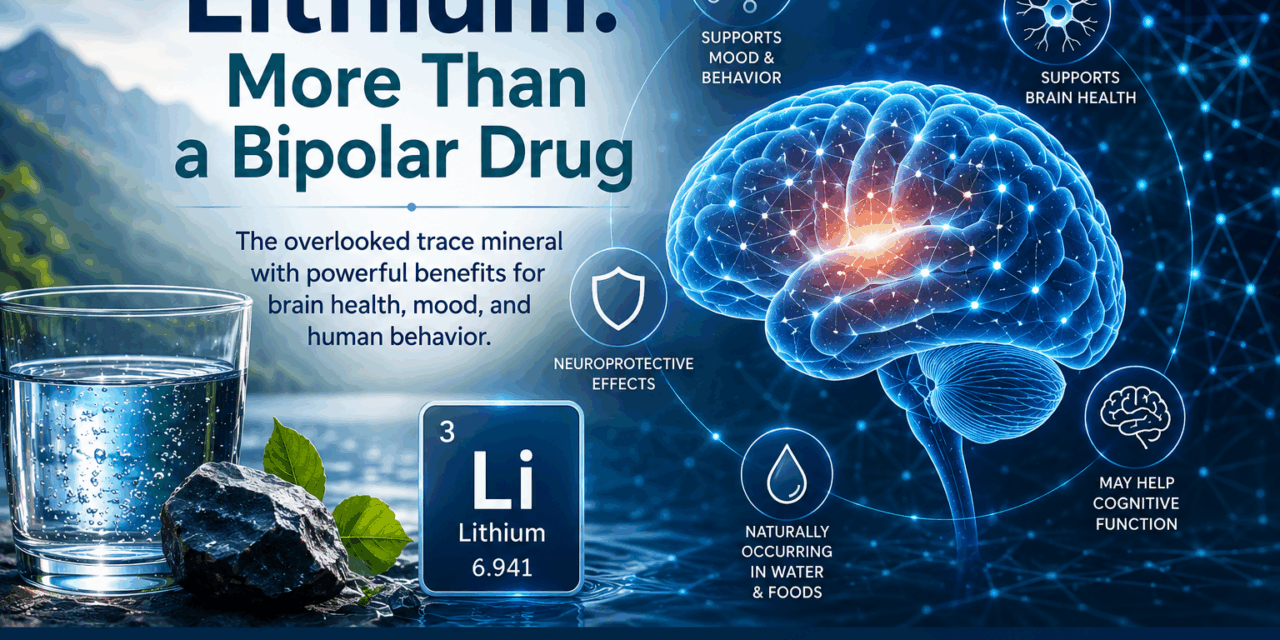
Lithium Is a Necessary Trace Mineral—We Are NOT Talking About the Drug
Most people think of lithium as lithium carbonate, which is taken at high doses for patients with bipolar disorder. These patients are given 600-1,200 mg/day of lithium carbonate (113-226 mg of elemental lithium). Studies have shown that lithium is an important trace nutrient when given at a dose of less than 20mg/day1.
Lithium: Good for Mood And Behavior
Lithium, as a trace nutrient, supports the brain, nervous system, mood, and behavior. Positive results have been noted in areas where lithium is found in the drinking water. The authors of one analysis stated, “These results suggest that lithium has moderating effects on suicidal and violent criminal behavior at levels that may be encountered in municipal water supplies. Comparisons of drinking water lithium levels, in the respective Texas counties, with the incidences of arrests for possession of opium, cocaine, and their derivatives (morphine, heroin, and codeine) from 1981-1986 also produced statistically significant inverse associations, whereas no significant or consistent associations were observed with the reported arrest rates for possession of marijuana, driving under the influence of alcohol, and drunkenness. These results suggest that lithium at low dosage levels has a generally beneficial effect on human behavior, which may be associated with the functions of lithium as a nutritionally-essential trace element.2” Lithium has been inversely related to aggression, and suicidal and homicidal violence3. One group of authors suggested fortifying cereals and other foods as a way of curbing societal violence4.
Lithium Protects the Nervous System
Lithium is especially important during early fetal development as evidenced by the high lithium content of the embryo during the early gestational period3.
Neuroprotective effects of lithium: Lithium upregulates Bcl-2, which are proteins that inhibit cell death6. These proteins regulate and mediate the process by which mitochondria contribute to cell death known as the intrinsic apoptosis pathway.
Lithium also upregulates BDNF7. The BDNF gene provides instructions for making a protein found in the brain and spinal cord called brain-derived neurotrophic factor. This protein promotes the survival of nerve cells (neurons) by playing a role in the growth, maturation (differentiation), and maintenance of these cells. Lithium protects cortical neurons from multiple insults, especially damage caused by glutamate7.
Lithium upregulates NGF. The NGF gene provides instructions for making a protein called nerve growth factor beta (NGFβ). This protein is important in the development and survival of nerve cells (neurons), especially those that transmit pain, temperature, and touch sensations (sensory neurons).
Lithium is a vital nutrient for the nervous system. One author concluded, “Lithium has been reported to be beneficial in animal models of brain injury, stroke, Alzheimer’s, Huntington’s, and Parkinson’s diseases, amyotrophic lateral sclerosis (ALS), spinal cord injury, and other conditions. A recent clinical trial suggests that lithium stops the progression of ALS5.”
Lithium is also important for enhancing transport of folate, and vitamin B12, into cells—offering further support to the nervous system. The transport of these factors is inhibited in lithium deficiency and restored by lithium supplementation3.
Lithium and Alzheimer’s Disease
One mechanism that has been proposed for the development of Alzheimer’s disease involves BDNF. During the course of the disease, BDNF levels decrease, correlating with the severity of dementia8. Authors of another study stated, “The decrease of BDNF serum levels in Alzheimer’s disease and normal pressure hydrocephalus may reflect a lack of trophic support and thus contribute to progressive degeneration in both diseases9.” Lithium upregulates BDNF7.
Studies have looked at lithium and the possibility that it could improve mild cognitive impairment and slow the progression of Alzheimer’s disease10,11,12,13. In one study, authors concluded, “Long-term lithium attenuates cognitive and functional decline in amnestic mild cognitive impairment (MCI) and modifies Alzheimer’s disease-related CSF biomarkers. The present data reinforces the disease-modifying properties of lithium in the MCI-Alzheimer’s disease continuum10.” One study used 300 micrograms/day of lithium and had good results14.
Anti-inflammatory and Antioxidant Effects of Lithium
Lithium has the ability to reduce inflammation through a reduction in brain arachidonic acid metabolism15. All chronic diseases possess some degree of inflammation. Lithium has the ability to reduce inflammation—in small, nutritional doses, devoid of the side effects commonly seen with high-dose therapy.
Lithium may protect the nervous system through antioxidant activity16. One study suggested that lithium’s ability to control a manic episode may be through an antioxidant mechanism17.
Lithium and Substance Abuse
Alcoholism: The observation that areas with high amounts of lithium in the drinking water had a lower incidence of alcoholism led to speculation that lithium may help with recovery from alcoholism. Although there have been studies with high-dose lithium carbonate, one study looked at 42 patients and utilized 150 mg/day of lithium orotate (about 6.5 mg of elemental lithium).
The authors describe the study, “Subjects were given a diet low in simple carbohydrates and containing moderate amounts of protein and fat. In addition, calcium orotate (for hepatic involvement), magnesium orotate, bromelaine, and essential phospholipids (for cardiac problems), and supportive measures were instituted, if required. Ten of the patients had no relapse for over three and up to 10 years, 13 patients remained without relapse for 1 to 3 years, and the remaining 12 had relapses between 6 to 12 months. Further advantages for this lithium therapy were noted, i.e., improved liver and cardiovascular functions, reduction (and in some cases abolishment) of migraine headaches, alleviation of the Meniere’s symptoms, and amelioration of seizures. There were increases in the white blood cell counts in the patient with chemotherapy-induced leukopenia and reduction of edema and ascites in patients with liver cirrhosis, as well as the pleural effusions and lymph node swelling in the patient with lung cancer. No manic episodes occurred during lithium orotate treatment in three patients with this affective disorder. The hyperthyroid condition was also improved in four patients.18” Eight patients developed muscle weakness, loss of appetite or mild apathy. For these patients, the symptoms subsided when the daily dose was given 4 to 5 times weekly.
Lithium and drug abuse: A total of 24 subjects, were randomly divided into two groups. The test group received 400 micrograms/d of lithium orally, in tablets composed of a naturally lithium-rich brewer’s yeast, for four weeks. The placebo group was given normal, lithium-free brewer’s yeast. All the subjects of the study were former drug users (mostly heroin and crystal methamphetamine). Some of the subjects were violent offenders or had a history of domestic violence. The subjects completed weekly self-administered mood test questionnaires, which contained 29 items covering parameters measuring mental and physical activity, ability to think and work, mood, and emotionality. In the lithium group, the total mood test scores increased steadily and significantly during the period of supplementation19.
The drug study was small, and the alcohol study was not double-blind, or placebo controlled. The results of both studies are encouraging, and lithium supplementation is worth looking into. The side effects in the alcohol study were minor and were alleviated when the dosage was reduced. The amount of lithium in the alcohol study (6.5 mg/day) was relatively high compared to some other nutritional uses of lithium.
Lithium and Mercury Toxicity
Symptoms of mercury toxicity include irritability, depression, anxiety, sensitivity to stress, and emotional lability. These are similar to the symptoms of lithium insufficiency in humans. Mercury increases oxidative stress, as well as levels of glutamate (an excitatory neurotransmitter) in the brain by impairing glial function, while lithium has a modulating and opposing action on glutamate (NDMA) receptors20,1.
Low Dose Lithium Therapy
Low dose lithium orotate is very stable and is thought to be absorbed and transported largely intact (un-ionized) through the intestinal lumen, and delivered to their sites of action within the cell. The pharmaceutical forms of lithium, carbonate, and citrate, readily ionize and produce extracellular lithium ions, which diffuse less efficiently into the cell via sodium channels. In other words, lithium orotate is more efficiently utilized by the cell, making high doses unnecessary1.
The most common side effects of high dose lithium are feeling or being sick, diarrhea, a dry mouth, and a metallic taste in the mouth. Symptoms of lithium toxicity include severe nausea and vomiting, severe hand tremors, confusion, and vision changes. These can be avoided by utilizing lithium as a low-dose nutrient.
This Is VERY Different From Pharmaceutical Lithium
“In general, the more ionizable forms of minerals cause greater side effects and “biological disruption” due to their extracellularly irritating nature. For example, copper and zinc can produce nausea in relatively small doses, and poorly absorbed forms of iron (e.g. sulfate) can cause intestinal irritation, nausea, and constipation. From a firmer understanding of the various forms of lithium and other mineral nutrients, one can navigate the nutritional and pharmacological realm with greater precision and desired effect, yielding fewer unwanted side effects, and more positive clinical outcomes.1”
Why Lithium Orotate?
Orotates are the mineral salts of orotic acid. Dr. Hans Neiper, a rather controversial figure, postulated that minerals bound to orotates are more easily transported through cell membranes than other forms. Orotate salts are more electrically neutral than other mineral salts and are therefore more lipophilic, making them easier to be transported through the cell membrane (which has two lipid layers).
Orotic acid (OA) was once considered to be a vitamin (B13). Although orotic acid isn’t officially considered a vitamin these days, over 40 years ago it was found to have growth-promoting, vitamin-like properties when added to the diets of laboratory animals. Subsequent nutritional studies in humans and animals revealed that OA has a “sparing” effect on vitamin B12, meaning that supplemental OA can partially compensate for B12 deficiency. OA also appears to have a direct effect on folate metabolism.
Selected References:
- Biol Trace Elem Res. 2019; 189(1): 18–27 Is Lithium a Micronutrient? From Biological Activity and Epidemiological Observation to Food Fortification
- Biol Trace Elem Res. 1990 May;25(2):105-13 Lithium in drinking water and the incidences of crimes, suicides, and arrests related to drug addictions
- J Am Coll Nutr. 2002;21(1):14–21. Lithium: occurrence, dietary intakes, nutritional essentiality.
- Med Hypotheses. 2016 Apr;89:40-2. Is violence in part a lithium deficiency state?
- Cell Transplant 2009;18:951-975 Review of lithium effects on brain and blood
- J Clin Psychiatry 2000;61(Suppl 9):82-96. 18. Lithium up-regulates the cytoprotective protein Bcl-2 in the CNS in vivo: a role for neurotrophic and neuroprotective effects in manic depressive illness
- Seishin Shinkeigaku Zasshi 2003;105(1):81-86 Neuroprotective actions of lithium
- J Neural Transm 2006;113:1217-1224. Stage-dependent BDNF serum concentrations in Alzheimer’s disease
- J Psychiatr Res. 2007 Aug;41(5):387-94 BDNF serum and CSF concentrations in Alzheimer’s disease, normal pressure hydrocephalus and healthy controls
- Br J Psychiatry. 2019 Nov;215(5):668-674 Clinical and biological effects of long-term lithium treatment in older adults with amnestic mild cognitive impairment: randomised clinical trial
- Br J Psychiatry. 2011 May;198(5):351-6 Disease-modifying properties of long-term lithium treatment for amnestic mild cognitive impairment: randomised controlled trial
- ACS Chem Neurosci 2014;5:443–450 Neuroprotective effects of lithium: implications for the treatment of Alzheimer’s disease and related neurodegenerative disorders
- Drugs Aging, 2012;29:335-342. 25 Does lithium prevent Alzheimer’s disease?
- Curr Alzheimer Res 2013;10(1):104-107. 27. Microdose lithium treatment stabilized cognitive impairment in patients with Alzheimer’s disease
- J Neurochem. 2007 Aug;102(3):761-72. Chronic lithium administration attenuates up-regulated brain arachidonic acid metabolism in a rat model of neuroinflammation
- Ann Clin Psychiatry 2015;27(1):49-54 Is lithium a neuroprotective agent?
- Neurosci Lett. 2007 Jun 21;421(1):33-6. Oxidative stress parameters in unmedicated and treated bipolar subjects during initial manic episode: a possible role for lithium antioxidant effects
- Alcohol Volume 3, Issue 2, March–April 1986, Pages 97-100 Lithium orotate in the treatment of alcoholism and related conditions
- Biol Trace Elem Res 1994;40:89-101 Effects of nutritional lithium supplementation on mood. A placebo-controlled study with former drug users
- J Neurochem 2002;80:589-597 Lithium protection against glutamate excitotoxicity in rat cerebral cortical neurons: involvement of NMDA receptor inhibition possibly by decreasing NR2B tyrosine phosphorylation







