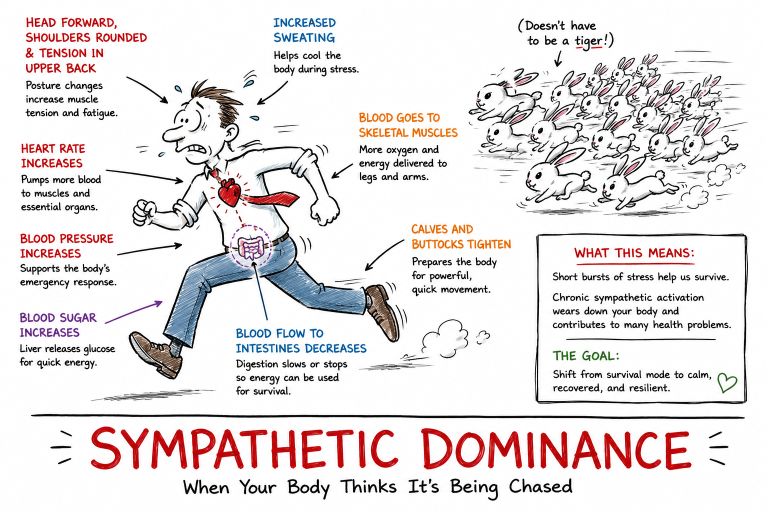
The “chased” feeling is sympathetic dominance. The sympathetic nervous system triggers the “fight or flight” stress response. It is about stress, with the body inappropriately acting like it is in danger. Unfortunately, your body reacts to emails, traffic, financial stress, and bad news much the same way it would react to a predator.
Changes Brought on by Stress
- Blood pressure increases
- Heart rate increases
- Blood moves to skeletal muscles and away from the intestines.
- Head moves forward, with tension increases in the neck, upper back, and shoulders.
These patients will feel keyed up, unable to calm down. They may startle easily. They may have trouble falling asleep. They will have a tendency towards high blood pressure and metabolic syndrome. They may sweat profusely or have sweaty hands. The patient may have ulcers.
What Is Sympathetic Dominance?
Sympathetic dominance may play a role in musculoskeletal pain, as many chiropractors can attest. What happens when you scare or anger a cat? The hair on the back stands on end because the muscles tighten. That is a sympathetic response. Southerners have a term, “get your back up,” to describe the same thing.
Stress Causes More Than Back Pain
Research has shown that simple stress reduction can alleviate back pain in cases of sympathetic dominance [1,2]. Low back pain may be the result of muscle tension or imbalance. The upper trapezius and neck muscles are often tight. They may have frequent tension headaches.
Stress causes problems that go beyond musculoskeletal pain. Many other health problems are linked to stress. A partial list includes:
- Anxiety
- Depression
- Digestive problems
- Headaches
- Muscle tension and pain
- High cholesterol
- Heart disease, heart attack, high blood pressure and stroke
- Sleep problems
- Weight gain
- Memory and concentration impairment
Focusing on the adrenal glands, and “hyperadrenia” is a common approach to helping these patients. While getting cortisol levels under control is helpful, there is more that needs to be done.
General Nutritional Support for Sympathetic Dominance.
Supplements can help, but… there is a downside. If you do not make the effort to improve your diet (download the Roadmap to Health), you will increasingly rely on pills. This is how people end up taking a sackful of vitamins. With that in mind, here are some supplements that may help. They may be useful short term as you improve your diet:
- Riboflavin facilitates vasodilation and has been shown to reduce blood pressure in studies [3,4] Similarly, low-dose lithium has been shown to stabilize the vascular endothelium, facilitate vasodilation, and reduce the risk for stroke [5]. Poor riboflavin status is a risk factor for stroke [9].
- Niacin has been shown to have cardiovascular benefits [6]. It improves lipid profiles, especially for those with insulin insensitivity [7,8].
- Other nutrients: The combination of choline and magnesium in the product reduces inflammatory markers and improves the function of vascular endothelium [10].
Mental Attitude Is a Key to Controlling Sympathetic Dominance.
What do you say when you talk to yourself? What you think and how you interpret things play a key role in stress biochemistry. If you are sleeping and hear a noise, for example, it will wake you up. If you think, “Oh, it’s just the wind.” You will go back to sleep. If you think, “My God! Someone is breaking in!” You will have a hard time getting back to sleep, even after you establish that there was no break in. Similarly, if you think, “Why is x, y or z happening to me?” with a sense of despair or victimhood, you are damaging your body. If you calmly think, “What can I do to improve x, y or z?” you preserve your health.
Anxiety, which is anxiously thinking about bad things (like the break in), creates stress, often where it does not exist. Anti-anxiety medications are designed to boost GABA, which is an inhibitory neurotransmitter in an effort to calm patients down. GABA is available as a supplement, but you can also enhance its production by ensuring that you eat a whole food diet that is high in B vitamins and magnesium.
Mental Attitude and Nutritional Biochemistry Are Linked
Anxiety and depression can contribute to sympathetic dominance, as can anger. We all know that the folate, the P-5-P and the B12 in the product can help reduce homocysteine levels. High homocysteine levels are linked to hostility and anger [8]. Low folate, B12, and B6 (P-5-P) levels are all linked to depression [11-14]. Lithium is a vital nutrient for the nervous system [15]. Lithium is also important for enhancing transport of folate, and vitamin B12, into cells—offering further support to the nervous system [16].
Biochemistry is linked to stress: For example, riboflavin deficiency triggers stress response systems [17]. B vitamins, in general, help to control stress [18]. Thiamin, in particular, helps reduce stress and decrease anxiety [19-21]. Bentfotiamine is a more biologically available form of thiamin [22,23]. The combination of magnesium and vitamin B6 have been studied and found to help reduce stress [24]. Magnesium and potassium have also been used to reduce blood pressure [25,26]. Sure, you can build a supplement list, but the important takeaway here is that DIET MATTERS.
Can More Be Done to Control Stress?
Lifestyle changes:
- Meditation
- Hobbies
- LIGHT exercise: Intense workouts are stressful. Tell the patient that he or she should be able to have a conversation while exercising.
- Breathing exercises.
- Healthy diet: Download the Roadmap to Health.
Selected References:
- JAMA 2016 Mar 22-29;315(12):1240-9 Effect of Mindfulness-Based Stress Reduction vs Cognitive Behavioral Therapy or Usual Care on Back Pain and Functional Limitations in Adults With Chronic Low Back Pain: A Randomized Clinical Trial
- Spine (Phila Pa 1976). 2017 Oct 15;42(20):1511-1520 Cost-effectiveness of Mindfulness-based Stress Reduction Versus Cognitive Behavioral Therapy or Usual Care Among Adults With Chronic Low Back Pain
- Am J Clin Nutr. 2012 Mar;95(3):766-72 Riboflavin offers a targeted strategy for managing hypertension in patients with the MTHFR 677TT genotype: a 4-y follow-up
- 2013 Jun;61(6):1302-8 Blood pressure in treated hypertensive individuals with the MTHFR 677TT genotype is responsive to intervention with riboflavin: findings of a targeted randomized trial
- Front Physiol 2016 Dec 6;7:593 Low-Dose Lithium Stabilizes Human Endothelial Barrier by Decreasing MLC Phosphorylation and Universally Augments Cholinergic Vasorelaxation Capacity in a Direct Manner
- J Clin Lipidol. 2018 May-Jun;12(3):810-821.e1 Niacin action in the atherogenic mixed dyslipidemia of metabolic syndrome: Insights from metabolic biomarker profiling and network analysis
- Medicine (Baltimore). 2020 Jul 17;99(29):e21235. Effectiveness of niacin supplementation for patients with type 2 diabetes: A meta-analysis of randomized controlled trials
- Lipids Health Dis. 2016 Jul 12;15(1):116 Effects of extended-release niacin/laropiprant on correlations between apolipoprotein B, LDL-cholesterol and non-HDL-cholesterol in patients with type 2 diabetes
- Eur J Clin Nutr. 2007 Oct;61(10):1237-40 Riboflavin status in acute ischaemic stroke
- J Nutr. 2005 May;135(5):978-82. Riboflavin deficiency impairs oxidative folding and secretion of apolipoprotein B-100 in HepG2 cells, triggering stress response systems
- Stoney CM, Engebretson TO. Plasma homocysteine concentrations are positively associated with hostility and anger. Life Sci. 2000;66:2267–75.
- Any depression from OC-altered vitamin B6 levels? [Answer to question of Jan Marquand. Contracept Technol Update. 1981;2(9):121–3. 1981 Sep.
- Fava M, Borus JS, Alpert JE, Nierenberg AA, Rosenbaum JF, Bottiglieri T. Folate, vitamin B12, and homocysteine in major depressive disorder. American Journal of Psychiatry. 1997;154(3):426–428.
- Tolmunen T, Hintikka J, Ruusunen A, Voutilainen S, Tanskanen A, Valkonen VP, Viinamaki H, Kaplan GA, Salonen JT. Dietary folate and the risk of depression in Finnish middle-aged men. A prospective follow-up study. Psychother Psychosom. 2004;73(6):334–9.
- Cell Transplant 2009;18:951-975 Review of lithium effects on brain and blood
- J Am Coll Nutr. 2002;21(1):14–21. Lithium: occurrence, dietary intakes, nutritional essentiality
- J Nutr. 2005 May;135(5):978-82. Riboflavin deficiency impairs oxidative folding and secretion of apolipoprotein B-100 in HepG2 cells, triggering stress response systems
- Hum Psychopharmacol. 2011 Oct;26(7):470-6 The effect of 90 day administration of a high dose vitamin B-complex on work stress
- International Journal of Clinical Medicine, 2011, 2, 439-443 439 doi:10.4236/ijcm.2011.24073 Published Online September 2011 (http://www.SciRP.org/journal/ijcm) The Impact of Thiamine Treatment on Generalized Anxiety Disorder
- Prog Neuropsychopharmacol Biol Psychiatry. 2017 Apr 3;75:148-156. Thiamine and benfotiamine improve cognition and ameliorate GSK-3β-associated stress-induced behaviours in mice
- Lonsdale D, Shamberger RJ. Red cell transketolase as an indicator of nutritional deficiency. American Journal of Clinical Nutrition. 1980;33(2):205–11.
- Ann Nutr Metab. 1991;35(5):292-6. Bioavailability assessment of the lipophilic benfotiamine as compared to a water-soluble thiamin derivative
- J Clin Pharmacol. 2014 Jun;54(6):688-95 Pharmacokinetic study of benfotiamine and the bioavailability assessment compared to thiamine hydrochloride
- Magnes Res. 2020 Aug 1;33(3):45-57 Impact of magnesium supplementation, in combination with vitamin B6, on stress and magnesium status: secondary data from a randomized controlled trial
- Magnes Res. 2021 Aug 1;34(3):130-139. Magnesium citrate supplementation decreased blood pressure and HbA1c in normomagnesemic subjects with metabolic syndrome: a 12-week, placebo-controlled, double-blinded pilot trial
- Am J Cardiol. 2016 Sep 15;118(6):849-853. Effects of Potassium Magnesium Citrate Supplementation on 24-Hour Ambulatory Blood Pressure and Oxidative Stress Marker in Prehypertensive and Hypertensive Subjects
- Bauerly K, Rucker RB. Pantothenic acid. In: Zempleni J, Rucker RB, McCormick DB, Suttie JW, eds. Handbook of vitamins. 4th ed. Boca Raton: CRC Press; 2007:289-314.
- Stein J Objective demonstration of the organspecific effectiveness of cellular preparations. Schmid F, ed. Cell Research and Cellular Therapy, Ott Publsihers, Thoune (Switzerland), 1967; pp295-301.